
Seasickness on a boat tour: how to prevent it
Prone to seasickness? General tips for the Acapulco boat tour: where to sit, what to eat, when the sea is calmer and what to do if you start feeling unwell.
By the Yates Dinka team Leer en español
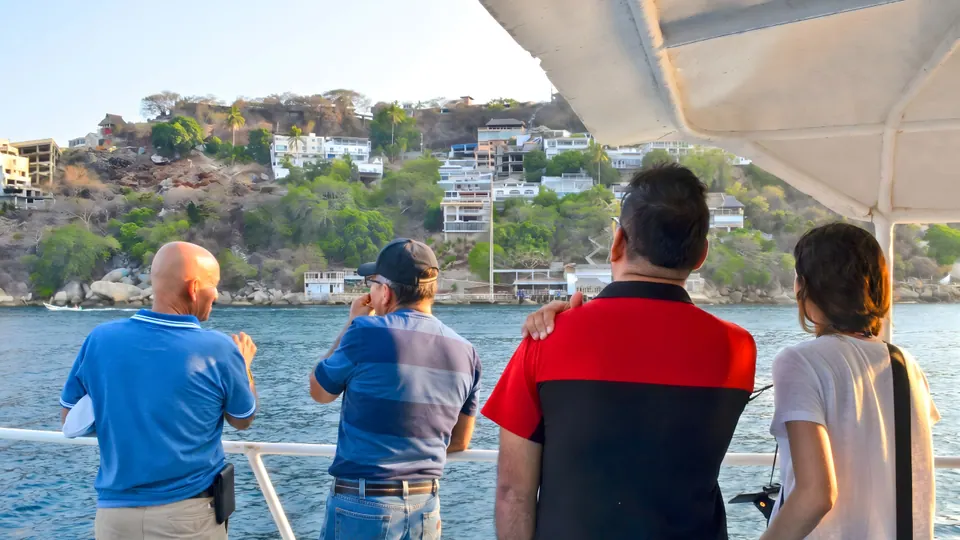
Quick answer: if you tend to get seasick, sit toward the middle of the boat, in the open air, look at a fixed point on the horizon, avoid heavy meals and alcohol before boarding, and stay off your phone. Nobody can promise you won’t feel sick, but these measures help most people. If you want to use a remedy, ask your doctor or pharmacist first: we don’t recommend medications here. The sea is usually calmer outside the months of ground swell.
This article is general information, not medical advice. If you have a health condition, are pregnant or travel with small children, check with a professional before the trip.
Why we get seasick on a boat
Motion sickness appears when what your eyes see doesn’t match what your inner ear feels: your body senses the sway, but your eyes, if they look at the inside of the boat, see something still. It is common, it is not a disease and it usually passes once you are back on land. Some people never get sick and others feel unwell with very little motion; it doesn’t depend on how “tough” you are.
Before boarding
- Eat something light at your usual time. A big, greasy or spicy meal before boarding doesn’t help, and neither does going completely hungry. The UK’s National Health Service (NHS) advises avoiding large meals, spicy dishes and alcohol just before or during a trip (NHS).
- Skip alcohol the night before and that morning if you know it affects you. A late night and a hangover make the discomfort worse.
- Sleep as well as you can. Tiredness and motion sickness don’t mix.
- Comfortable clothes that don’t squeeze your waist or abdomen.
- Ask your doctor or pharmacist first if you want to use a remedy. Over-the-counter options such as tablets or patches have minimum ages and side effects, and some must be taken in advance. That is why the decision belongs to a professional who knows your case, not to a travel blog. Ginger and acupressure bands are popular options, but evidence is limited and the NHS notes that bands “do not work for everyone”.
- Check the weather and sea the day before; below we talk about when it is wise to avoid certain dates.
Where to sit on the boat
What helps most is fresh air, so look for a spot where you catch the breeze off the bay.
- Toward the middle of the boat. That is where you feel the sway the least; the NHS recommends sitting near the centre of a boat to feel less motion.
- Where the breeze reaches you, not in a closed corner. Fresh air on your face helps many people.
- With a view outside. Pick a spot where you can see the coast or the horizon, not only the deck.
- Avoid the very edge of the bow or the stern if the rocking affects you a lot; the ends move more than the center.
If the boat is full, tell the crew you get seasick: they can point you to a good spot. With so many passengers you can’t always choose, but asking costs little.
During the tour
- Look at a fixed point in the distance, like the horizon line or an island. Don’t watch the waves go by or stare at the water near the hull.
- Avoid your phone, camera screens and reading. Taking a photo is fine, but don’t spend minutes with your eyes on a screen.
- Breathe slowly and deeply. Closing your eyes for a moment also helps.
- Sip water. Avoid alcoholic drinks on board.
- Distract children: talk, point out the birds, the celebrity homes, count fish. Putting their attention elsewhere lowers the discomfort.
- There is no restroom on board or at the pier. Go before you leave your hotel or restaurant, because discomfort makes any queasiness worse. There are restrooms on the island.
- If the glass bottom makes you queasy, don’t keep staring down at the moving waves: look up at the horizon and glance back down once it passes.
What to expect on the route
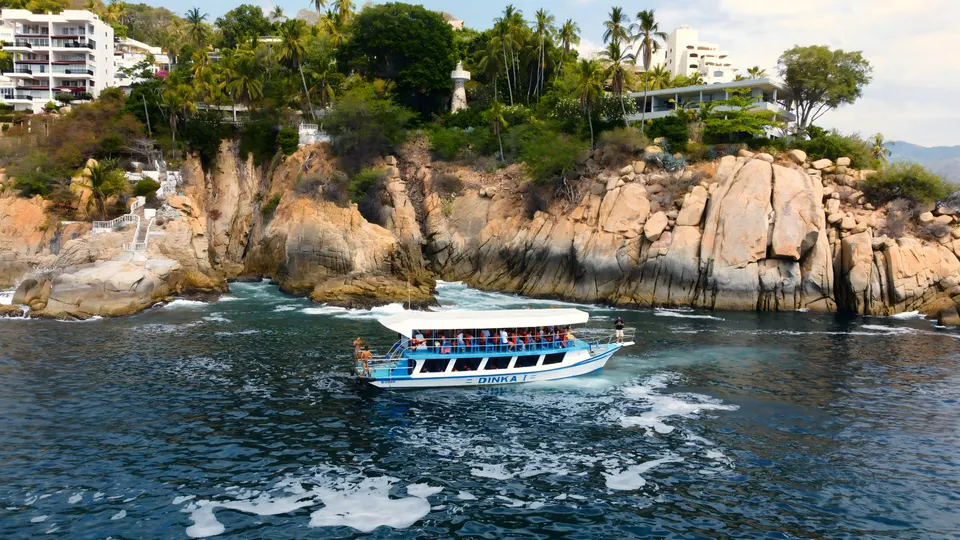
The Traditional Tour lasts from 90 minutes, always inside the bay: celebrity homes, the Elephant Rock, the dive at Punta Elefante, the Underwater Sanctuary of the Virgin of Guadalupe, fish feeding under the glass bottom and Roqueta Island. Onboard commentary is in Spanish. During the stops, the boat rocks without moving forward, and some people feel that as much as the motion. It is normal; look at the horizon and breathe.
If you start feeling unwell
- Tell the crew. You don’t have to tough it out.
- Sit down in the middle of the boat, back straight, head supported.
- Look at the horizon and breathe fresh air.
- Sip water. Avoid eating at that moment.
- Stop looking at screens.
- Once on the island, walk for a while on solid ground. Resting on a stable surface usually relieves it.
If the discomfort is strong or worries you, tell the crew; when in doubt, it is better to get help than to wait. This information does not replace a medical consultation.
With children
- Keep them occupied and give them a pleasant view: houses, birds, fish. The NHS suggests keeping children entertained with conversation, music or songs.
- Avoid heavy meals before the tour.
- If your child gets carsick, they will probably feel it here too. Ask their pediatrician or a pharmacist which options suit their age before the trip.
- Children ages 0 to 3 ride free on the Traditional Tour (so does a child who turns 4 on the day of the tour). More family tips in Acapulco with kids.
When the sea is calmer
We can’t promise you a sea condition for a given date, but these ideas help you choose:
- Ground swell, May to November. This is a continuous swell generated by storms far away; the season runs from May to November (Milenio, in Spanish), roughly the same months as the hurricane season. On those days the waves are stronger even when it is sunny. When it is dangerous, the port authority (Capitanía de Puerto) closes minor navigation, as happened in Acapulco and Puerto Marqués in June 2025 (UnoTV, in Spanish).
- Days with strong wind or after a storm the sea is usually rougher. More on the calendar in the best time to visit Acapulco.
- Light rain is not the same as a rough sea: we sail in a drizzle, and sometimes the sea stays calm.
If your date falls in a ground-swell week and you are worried, message us on WhatsApp before you go. And if the port closes, you can change the date at no cost or get a 100% refund: we explain it in what happens in bad weather.
If you already know you get very seasick
- Talk to your doctor before traveling.
- Prepare a simple plan: light breakfast, a seat in the middle, eyes on the horizon, no screens.
- If the Tour + Snorkel sounds like too much, the Traditional Tour has no snorkeling: you stay on the boat and go down to the island only if you want to. Snorkeling lasts 45 minutes with a life vest; if you feel unwell in the water, tell the instructor and get out of the water.
- See what to bring on the boat tour to be comfortable.
Frequently asked questions
Will I get seasick on the boat tour?
We can’t know: it depends on each person and on the sea that day. The route lasts from 90 minutes, inside the bay, and the measures above help most people.
Where is the best place to sit to avoid seasickness?
Toward the middle of the boat, in the open air, looking at the horizon or the coast.
What can I take for seasickness?
We don’t recommend medications. Ask your doctor or pharmacist before the trip; some remedies have minimum ages and side effects.
Can I eat before the tour?
Something light. Avoid heavy or spicy meals and alcohol before and during the tour, as the NHS advises.
Is there a restroom on board?
No, neither on board nor at the pier. Go before you arrive; there are restrooms on the island.
What if I feel sick while snorkeling?
Tell the instructor and get out of the water to rest. The equipment includes a life vest.
If you are ready: Traditional Tour · Tour + Snorkel · FAQ. WhatsApp and calls 744 187 3434.